
Georgetown University Admissions
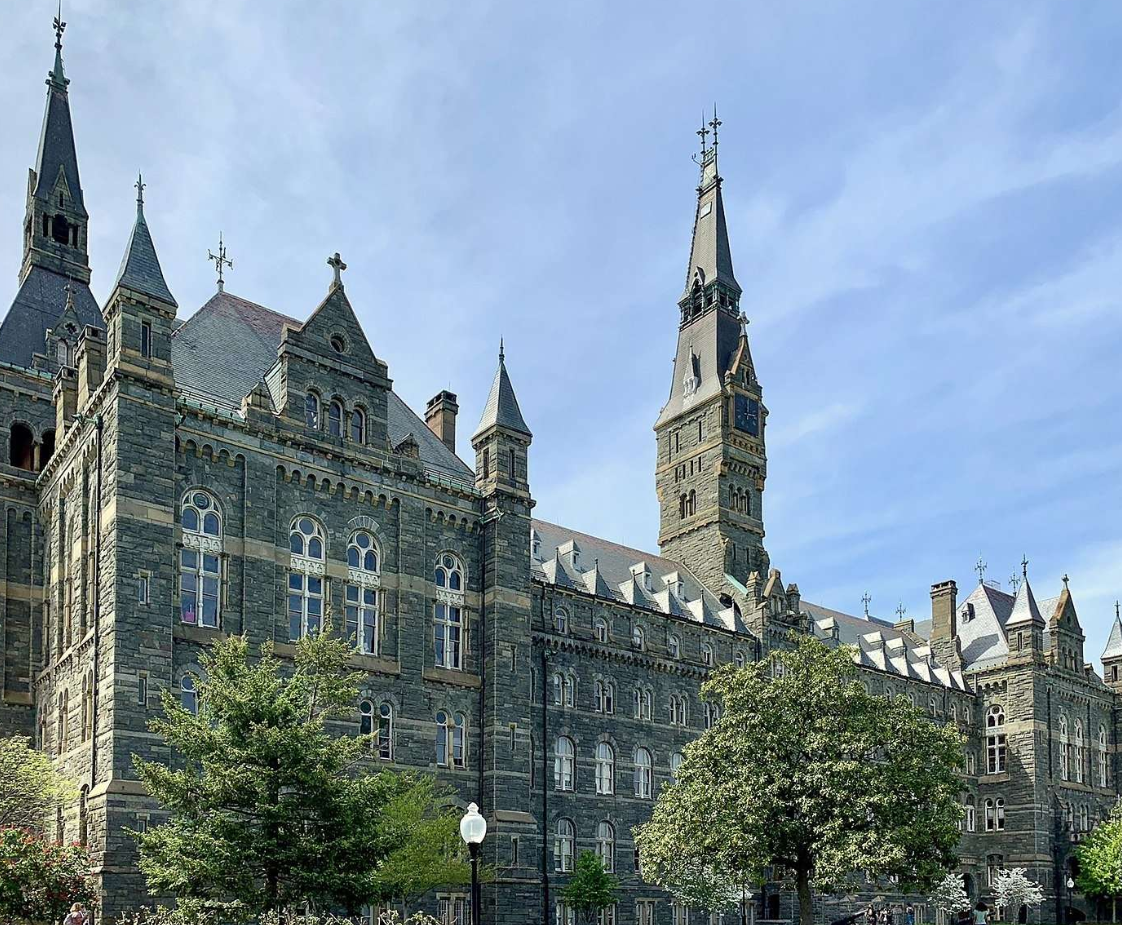
Georgetown was America’s first federally-chartered university (photo credit: APK).
Georgetown University offers up many contradictions upon initial inspection: it’s America’s first Catholic university, but also the nation’s first federally-chartered university. Its guiding principles are deeply informed by Jesuit teachings, but it also has a religiously and ideologically diverse student body. The university draws Catholic and non-Catholic students alike because of its world-renowned academics and history of producing political, economic, and cultural leaders. U.S. Presidents Bill Clinton and Lyndon B. Johnson count themselves among the ranks of Georgetown alumni, as well as many other heads of state, 28 Rhodes Scholars, and more U.S. diplomats than any other university. Additionally, a variety of Cabinet members, Supreme Court Justices, and other high level government officials serve as faculty.
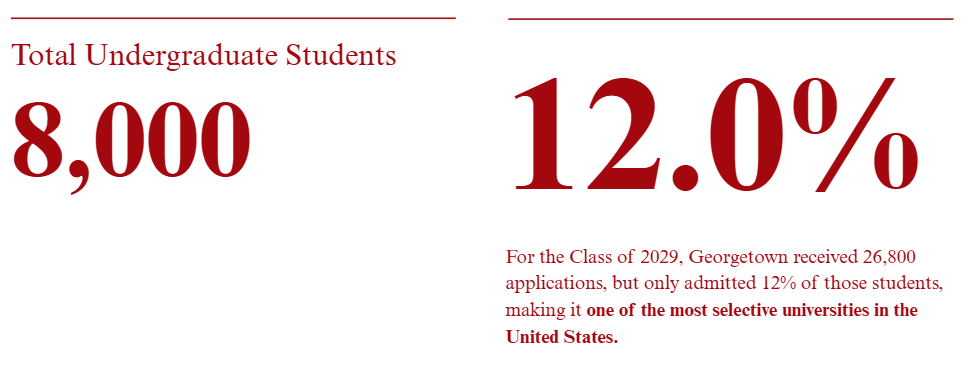
8,000 undergraduates receive bachelor’s in six schools: the College of Arts and Sciences, the School of Nursing, McDonough School of Business, the School of Continuing Studies, the School of Health, and the Walsh School of Foreign Service, which is widely regarded to be the greatest in the nation when it comes to the study of international affairs. Despite the variety of bachelor degrees offered, all students share a core curriculum that consists of required coursework in “Philosophy,” “Theology and Religious Studies,” “Writing,” “Humanities,” “Engaging Diversity,” and “Science.” 11,500 postgraduate students receive degrees in Law, Medicine, Nursing, Public & Foreign Policy, Business, and Arts & Sciences.
Georgetown was founded in 1789 by Jesuit clergy from Annapolis, Maryland. While it struggled financially for much of its early history, following the Civil War, Georgetown began to flourish when President Patrick Francis Healy reformed the undergraduate curriculum and made university status an institutional priority. Through the late nineteenth and twentieth centuries, Georgetown expanded its graduate-level offerings and its legacy of achievement. Today, The R1 research university spends over $240 million annually on research expenditures, operates four campuses internationally, and boasts some of the most lucrative professional outcomes for alumni amongst elite universities.
The university’s reputation for producing political and governmental leaders stems, in part, from its proximity to the bustle of Capitol Hill and the White House. Through the Georgetown Lecture Fund and the Office of Communications, heads of state frequently speak at Georgetown while visiting DC. Unsurprisingly, this culture of political engagement bleeds into the student body in the form of widespread activism. Political, social justice, and environmental groups have historically been incredibly active on campus and have exercised influence on administrative policies.
In addition to the robust activism scene on campus, students participate in a variety of extracurricular activities, including the Mask and Bauble Dramatic Society (the nation’s oldest university theater troupe), Students of Georgetown, Inc. (the nation’s largest student owned and operated cooperation), seven a cappella groups, and an internationally-renowned Model United Nations organization. 41% of the student body identify as Roman Catholic, 22% as Protestant, and 6.5% as Jewish. Greek life draws a slim 10% of the undergraduate population, and varsity athletic teams participate in Division I. On Halloween night, students gather for a viewing of The Exorcist, which was filmed in the surrounding neighborhood.
Getting into Georgetown requires a competitive application that demonstrates a holistic commitment to Jesuit values, regardless of religious affiliation. For admission to the Class of 2029, Georgetown accepted 12% of 26,800 applicants between its five schools. The Office of Undergraduate Admissions highlights the importance of qualities in prospective students such as “resiliency, motivation and ambition,” while also stressing that all students from diverse walks of life are welcome. The ideal Georgetown candidate is guided by empathy, curiosity, and a commitment to service. Successful applicants are sure to showcase how their actions will contribute to a culture of civic, spiritual, and intellectual engagement. If you dream of donning blue and gray and are wondering how to best convey that you are the right fit, look no further! OPUS will help you demonstrate that you will be the perfect Hoya.
