
Emory University Admissions
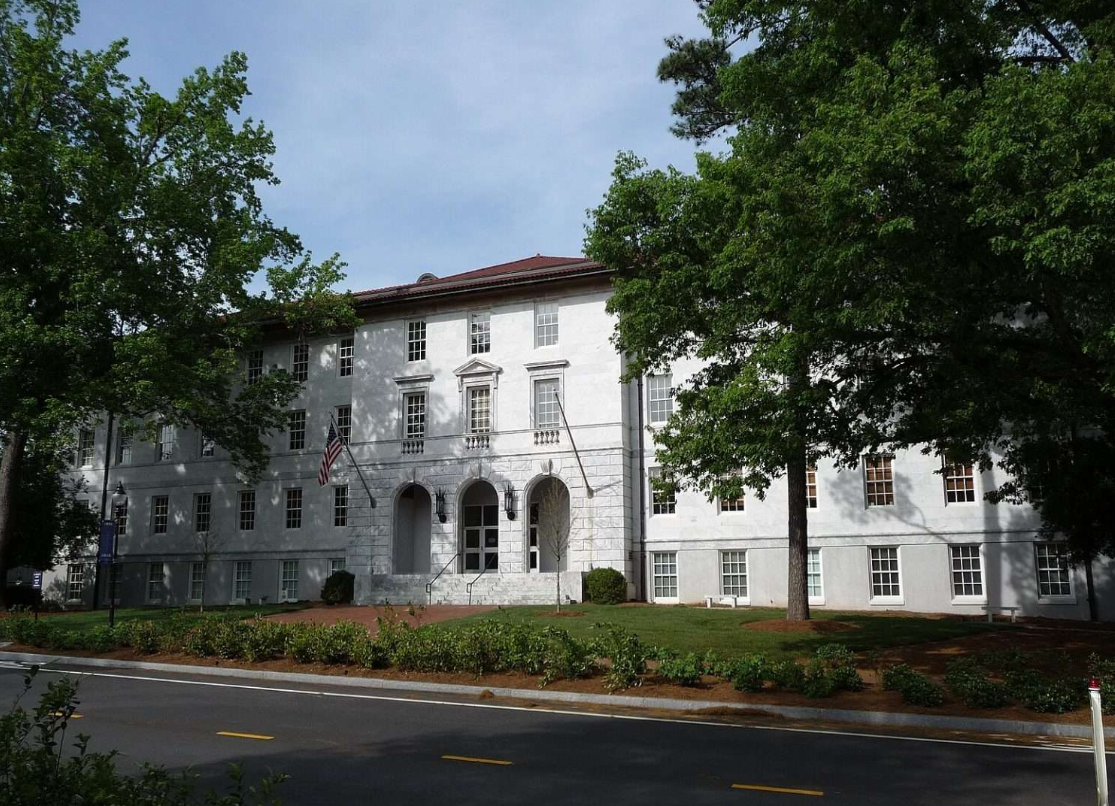
Emory University boasts two campus — in Oxford, Georgia and Atlanta, Georgia (photo credit: Daniel Mayer).
Emory University is the foremost institution in the world for public health and disease research. The university is responsible for generations of epidemiological innovations and research breakthroughs. Not only does Emory provide the state of Georgia with its largest healthcare system, through Emory Healthcare, but it also has historical affiliations with the nearby U.S. Centers for Disease Control and Prevention. In fact, in 1947, Emory donated 15 acres of its land for the creation of the CDC national headquarters. Located in the Druid Hills neighborhood of Atlanta, Georgia, Emory University was constructed in the Beaux-Arts style by architect Henry Hornbostel and sits on a 600 acre plot lush with greenery.
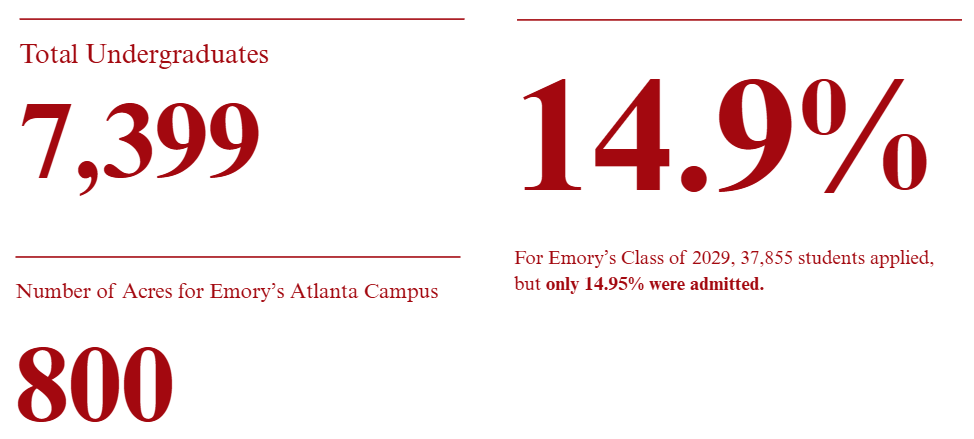
With current and former faculty such as the late U.S. President Jimmy Carter, author Salman Rushdie, and former CDC Director William Foege (who, for the record, was credited with the global eradication of Smallpox), Emory’s academic program goes virtually unrivaled in its renown in the American Southeast. Undergraduates, who number around 8,100 on campus, choose between enrolling in the Emory College of Arts and Sciences and the Neil Hodgson Woodruff School of Nursing to complete their Bachelor’s. Over 80 majors and 60 minors are offered. Students enrolled in the College of Arts and Sciences complete general education requirements in the following categories: “Success at Emory;” “Exploration Courses;” “Expression & Communication;” “Belonging & Community;” and “Experience & Application.
Emory University was founded as “Emory College” in Oxford, Georgia in 1836. The school was named for Methodist Episcopal Church bishop John Emory. Following the destruction of the campus during the Civil War, Emory’s Oxford campus had to be rebuilt using funds raised from Northern Industrialists. The Oxford campus remains active today, home to first and second-year students who enroll at Emory through its Oxford College option. Of the approximately 1,000 students enrolled at Oxford, many go on to the School of Arts and Science in Atlanta to complete their bachelor’s after two years without any additional application processes, while others opt to apply for admission to the business or nursing schools.
In 1915, Emory launched its campus in Atlanta following the donation of land by Asa Griggs Candler, founder of the Coca-Cola Company, which gained it the moniker “Coca-Cola University.” In the 1970s, Emory established one of the first African American studies programs in the South following decades of efforts to integrate the student body.
Today, Emory is classified as an R1 research university with ’very high research activity,” and receives nearly $900 million in annual research funding, most of which comes from the National Health Institutes. Additionally, the nursing and public health programs are nationally-ranked. The university houses the International Association of National Public Health Institutes. Through the Emory Vaccine Center, the university has led the charge of the creation of many major vaccines, and through the Center for AIDS Research, has made significant progress in developing an HIV vaccine.
Students at Emory engage with their campus community through a variety of organizations and programs that encourage community service, artistic development, and social camaraderie. One in four students participate in Volunteer Emory, the umbrella volunteering organization. The student newspaper is called The Emory Wheel. With 20% of the student body participating, Greek Life has a healthy presence on campus that dates back to the 1840s. The campus also houses several secret societies. Collegiate athletes compete in the NCAA’s Division III. Emory alumni, or “Eagles,” include former U.S. Vice President Alben Barkley, Korean politician and nationalist Yun Chi-ho, and civil rights activist Bernice King.
It is not easy to get into Emory, as acceptance rates for undergraduates have dropped precipitously in recent years. For admission to the Class of 2029, between Emory College and Oxford College, the university received a record-setting 37,855 applications and granted admission to 5,658 students, for an overall acceptance rate of 14.95%. Admission to Oxford College is slightly less competitive than at Emory College.
The Office of Undergraduate Admission states that successful applicants have a few things in common: “They tend to be high achievers who are engaged in their community and who are looking to make the world—in ways big and small—a better place.” In the face of unprecedented competitiveness in the college admissions process, students with their sights set on sporting Emory’s signature blue and gold need not look any further than OPUS. We will help you craft the strongest application possible to realize these dreams!
