
Amherst College Admissions
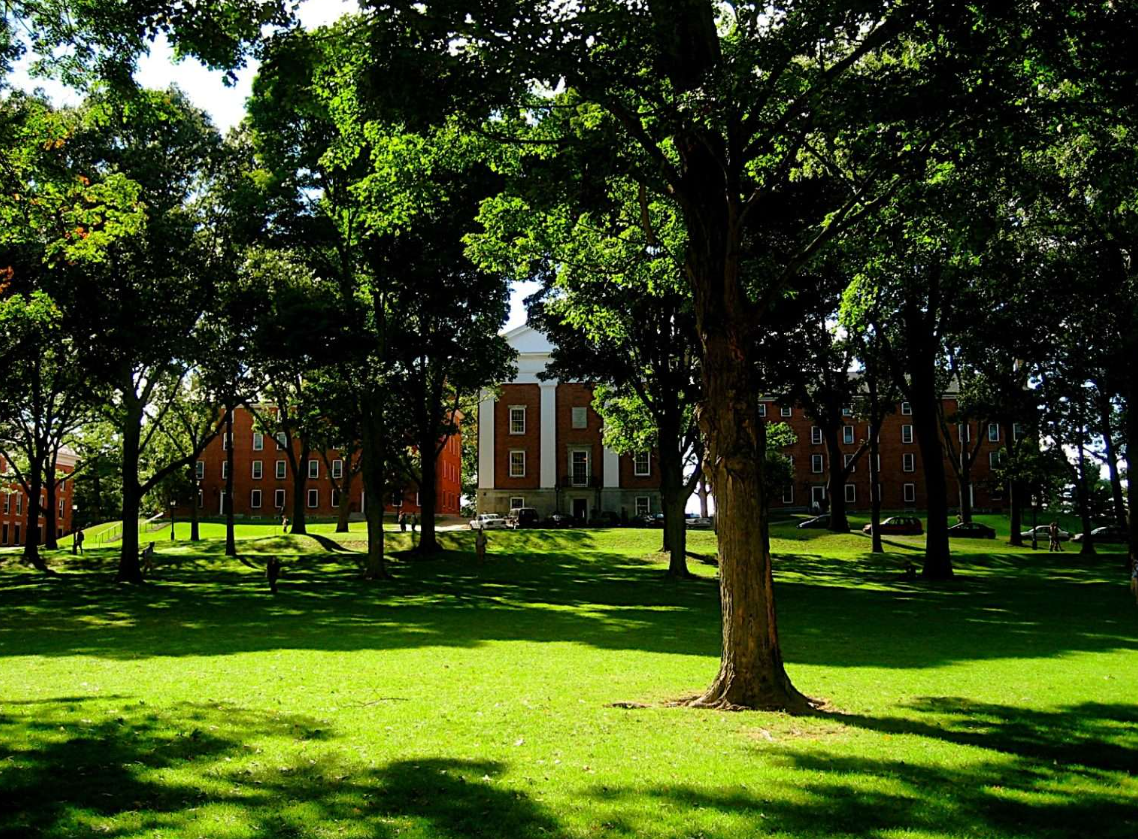
Amherst College has no core curriculum (photo credit: David Emmerman).
Amherst College might appear to be a run-of-the-mill liberal arts college with an open curriculum, a rural campus hidden within the fields and foliage of Western Massachusetts, and a laid-back student body, but make no mistake: Amherst is an intellectual powerhouse with alumni and faculty that have been lavished with success in all major industries. Its huge $3.55 billion endowment provides for a student body of just 1,910 students, all of whom are undergraduates. This small collegiate community creates life-long Amherst Mammoths out of alumni, around half of whom go on to become annual donors to the college. This elite group has included U.S. President Calvin Coolidge, along with five Nobel Prize winners: Jeffrey Hall, Henry Kendall, Edmund Phelps, Harold Varmus, and Joseph Stiglitz.
Unlike its primary historical rival, Williams College, Amherst has no core curriculum. It instead encourages a “flexibility and independence” to coursework that is guided by faculty advisers. Not only does Amherst offer 42 majors, but the college was one of the first to pioneer interdisciplinary fields of study, allowing students to submit proposals for independent interdisciplinary pursuits or to join unorthodox discipline-bending departments such as Law, Jurisprudence & Social Thought or American Studies. As a result of the lack of distribution requirements, a little less than half of students opt to double major. As a member of the Five College Consortium, Amherst allows students to take classes at neighboring Mount Holyoke College, Smith College, Hampshire College, and UMass Amherst.
Amherst was established in 1821 by the sitting President of Williams, Zephaniah Swift Moore, who moved to Amherst, Massachusetts, along with 15 former Williams students, due to his conviction that Williams was a failing institution. While established without an official religious affiliation, Amherst maintained strong ties to the Puritan establishment in New England and its attendant Calvinism throughout the 19th century. Amherst’s last few decades have been marked by several major liberal reforms, including becoming coeducational in 1975, abolishing fraternities in 1984, and ending legacy admissions advantages in the recent admissions cycle.
The college still occupies a charming, small-scale campus in the hills of rural Massachusetts, but it has a global reach and esteemed reputation that puts it on par with elite institutions across the nation. Students at Amherst spread their time and energy between 150 student organizations, a strong Division III Athletics program (which forms an infamous trifecta, the “Little Three,” with rivals Williams and Wesleyan), a variety of art, history, and science museums accessible through the Five Colleges Consortium, and a social scene that eschews the exclusivity of Greek life for democratic inclusivity. Those who are lucky enough to attend Amherst are rewarded for their academic distinction with classes taught by some of the brightest minds in higher education, which in the past have included Pulitzer Prize winners William Taubman, Lewis Spratlan, Archibald MacLeish, and the incomparable American treasure Robert Frost.
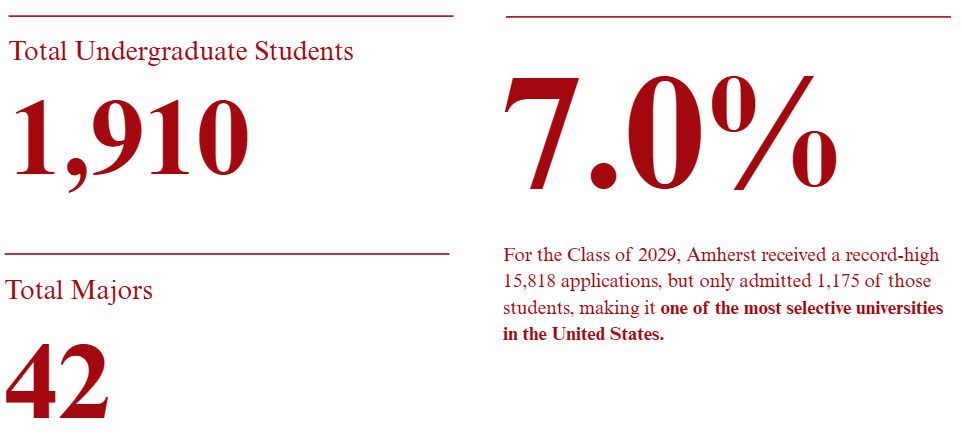
Those who were admitted to the Amherst Class of 2029 were evaluated for the third time in recent history without preference given to legacy status. Out of 15,818 applicants (the most in the school’s history!), 7% were granted admission. This represents an acceptance rate that matches the record set three years prior, which stood at 7% for the Class of 2026 (The Amherst Student hastened to add that a similar jump in the acceptance rate occurred at Williams between the two cycles).
The Office of Admission emphasizes that successful Amherst students “embrace the academic freedom provided by our open curriculum.” In other words, they are signaling to prospective applicants that demonstrating academic passion and forethought about potential coursework is essential for a competitive application. If this sounds like a daunting task for a high schooler who is still exploring their academic horizons, turning to OPUS will help build the strongest application possible to optimize their case for admission to Amherst.
